
November 5, 2026
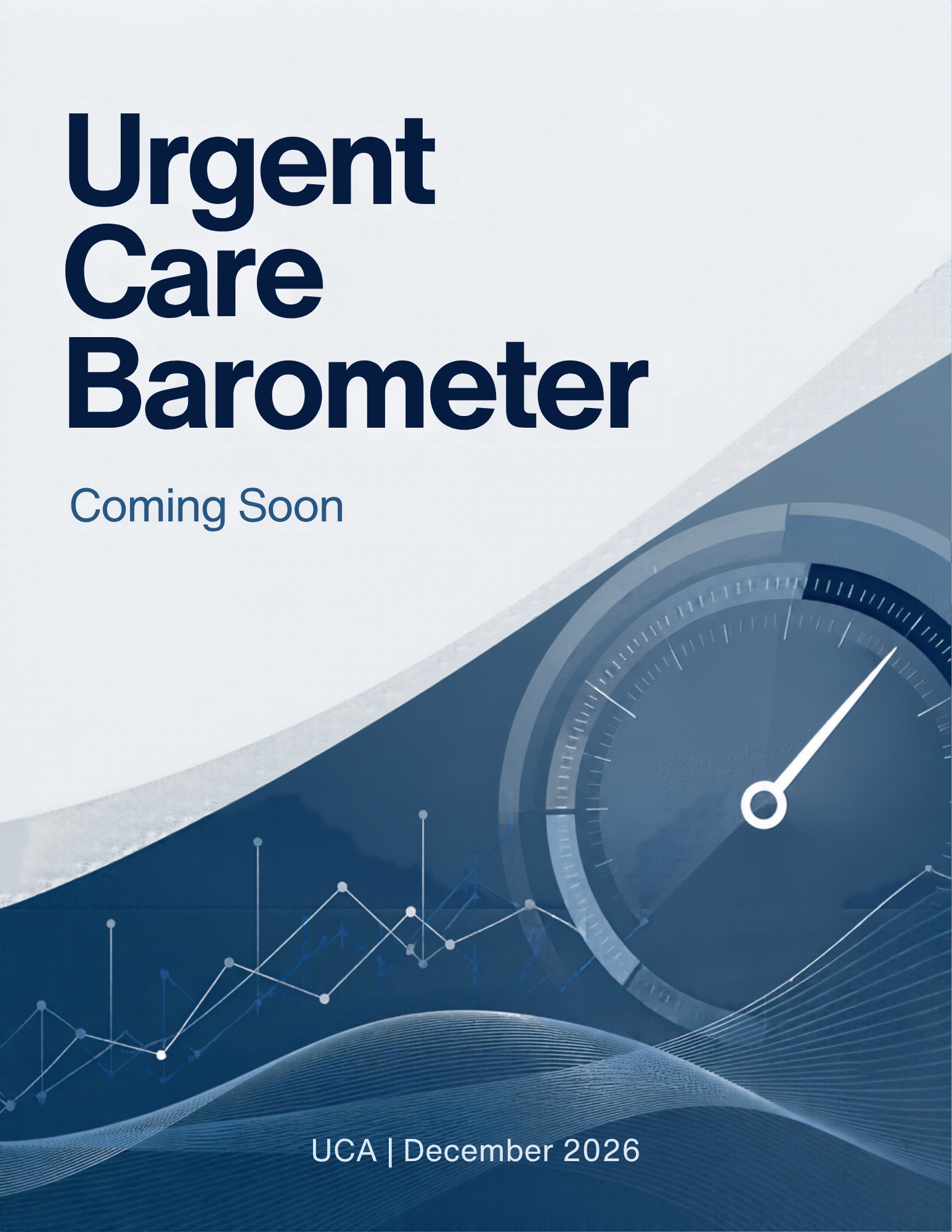
UCA’s first Urgent Care Barometer report arrives next month, giving Urgent Care leaders a quarterly snapshot of how the field is performing nationally and where it’s headed.
UCA members will get the full results first, with deeper analysis than what’s released publicly, helping them compare what they’re experiencing in their own centers and markets with national trends.
The inaugural edition, State of Urgent Care Entering 2027, will look at things like:
The data will come directly from Urgent Care leaders across the country, who are being surveyed this month. By asking the same core questions each quarter, UCA will track how the field changes over time and use the findings to strengthen Urgent Care’s case with Congress, payers and regulators.
Want to be part of it? We’re expanding the group of Urgent Care leaders who contribute to the Barometer. It takes about five minutes each quarter, and responses are confidential and reported only in aggregate. UCA members interested in joining for future quarters can reach out to Kristin Rastatter, Director of Advocacy.

Urgent Caring, the quarterly peer-reviewed publication of the Urgent Care College of Physicians (UCCOP) in collaboration with the College of Urgent Care Medicine (CUCM), is now accepting submissions for First Quarter 2027 and future issues.
Urgent Care is its own specialty — and the people who know it best are the ones practicing it every day. That’s you.
Submissions are accepted on a rolling basis and will be published at the discretion of the editors in an upcoming issue. Send your work whenever it’s ready, and we’ll place it in an upcoming issue.
Feature articles we’re looking for:
Not every contribution needs to be a full article. Short pieces are accepted too. These short items help fill out each issue, and they’re a great way to get involved:
We’re also looking for members willing to review submissions. It’s a great way to sharpen your own writing and give back to the specialty.
Why publish with Urgent Caring?
How to submit: Visit the link below and include your name, credentials, affiliation and a short title.
Want to run an idea by us first? Reach out — we’re happy to help you shape a topic.
Information for Authors
Articles submitted to Urgent Caring should be no longer than two pages, excluding images and references.
Use of Artificial Intelligence
Urgent Caring allows the responsible use of artificial intelligence (AI), when it is under the following recommendations: :
Original human thought. The central idea of every article, its essence, must be the original thinking of the author(s), not generated by AI. The majority of the article must be written by the author(s), and all content must be reviewed, verified and approved by them before submission.
Authorship. AI tools may not be listed or cited as authors. They cannot take responsibility for the work, approve the final version, declare conflicts of interest, or enter into copyright agreements.
Acceptable uses. AI may be used in a supporting role, such as checking spelling and grammar, formatting, assisting with literature searches, or improving clarity. It should not be used to generate an article’s concept, arguments, or conclusions.
Disclosure. Any use of AI beyond the acceptable uses described above, such as creating or altering images and graphics or collecting and analyzing data, must be disclosed at submission and in the article, naming the tool, its version and how it was used.
Accountability. Authors are fully responsible for everything in their article, including any portion produced with AI assistance. This includes confirming that every reference is real and correctly cited and that no content is plagiarized. Undisclosed or inappropriate AI use will be treated as a breach of publication ethics
Let’s keep building the evidence base for Urgent Care — by Urgent Care.
Tracey Quail Davidoff, MD, FCUCM, and Cesar Mora Jaramillo, MD, FAAFP, FCUCM
Editors-in-Chief, Urgent Caring
